How to Turn What You Know Into a Clear Online Course
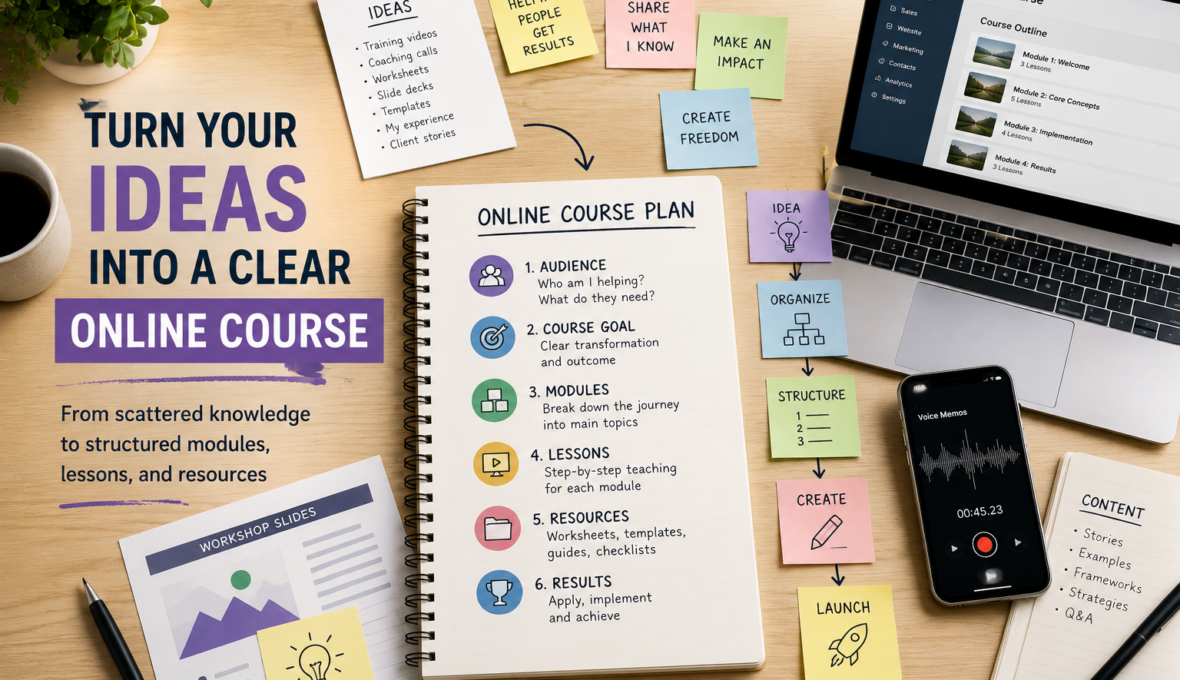
A Practical Guide to Organising Your Knowledge Into Modules, Lessons, and Learning Resources
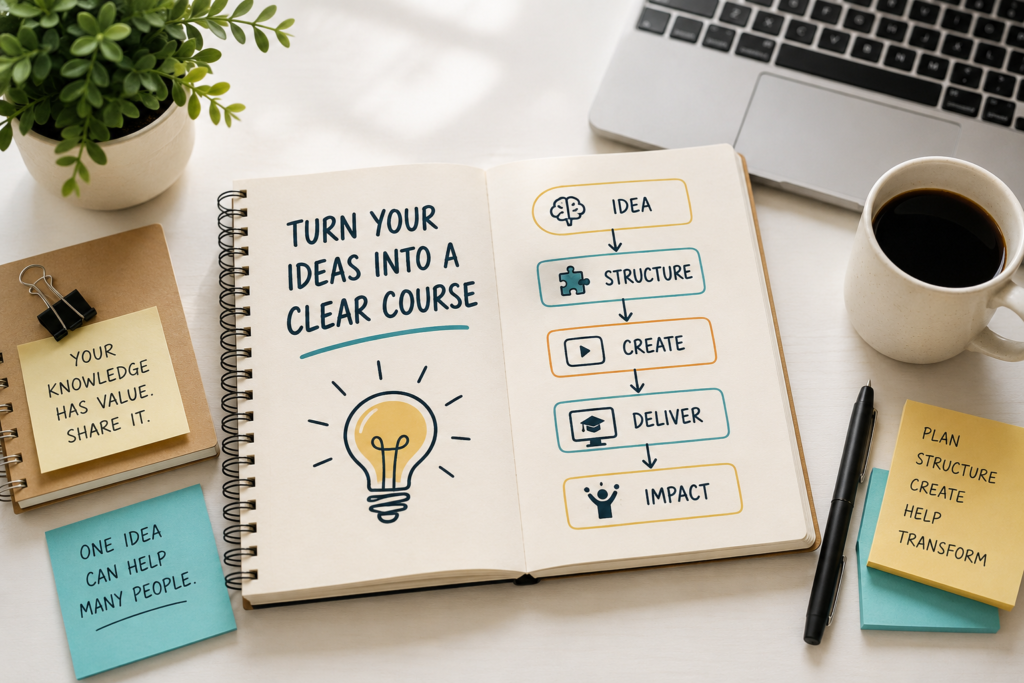
You may already have the knowledge for your online course.
The problem is that it may not look like a course yet.
Some of your ideas may be in your head.
Some may be in notebooks, voice notes, Google Docs, presentation slides, old workshops, YouTube videos, client calls, WhatsApp messages, or training recordings.
You know what you want to teach, but when you try to bring everything together, it can quickly feel overwhelming.
What should come first?
How many modules should you create?
What should each lesson cover?
Which parts should become videos, workbooks, guides, templates, or checklists?
How do you make sure the course is not only informative, but also easy for people to follow and complete?
The answer is not to keep creating more content.
The first step is to bring structure to what you already know.
1. Start With the Result, Not the Content
Before you start creating modules or recording videos, decide what your learners should be able to understand, do, improve, or achieve by the end of the course.
Ask yourself:
- Who is this course for?
- What problem are they currently facing?
- What should be different after they complete the course?
- What practical result should they walk away with?
For example, instead of saying:
This course teaches social media marketing.
You could make the outcome clearer:
By the end of this course, learners will be able to create a simple 30-day social media content plan for their business.
A clear outcome gives the whole course direction.
It helps you decide what belongs in the course and what should be left out.
2. Gather Everything You Already Have
Many experts believe they need to start from scratch.
Most of the time, they do not.
You may already have useful course content hidden inside:
- Training recordings
- Client questions
- Workshop slides
- Social media posts
- Voice notes
- YouTube videos
- Guides and templates
- Coaching calls
- Frequently asked questions
- Existing documents
- Stories and examples from your work
Bring everything into one place before trying to organise it.
At this stage, do not worry about whether the materials are polished.
The goal is simply to see what you already have.
You may discover that you have more than enough content to build the course.
3. Identify the Main Stages of the Journey
Think about the journey your learner needs to take from where they are now to the result you promised.
What major stages will they need to move through?
These stages can become your course modules.
For example, a course on creating an online programme could include:
- Clarifying the course idea
- Identifying the target learner
- Defining the course outcome
- Structuring modules and lessons
- Creating learning materials
- Setting up the course platform
- Preparing the course for launch
Each module should represent one meaningful stage in the learner’s progress.
The modules should follow a natural order.
A learner should not need information from Module 5 before they have completed Module 2.
4. Break Each Module Into Focused Lessons
Once the modules are clear, break each one into smaller lessons.
Each lesson should answer one main question or help the learner complete one clear action.
Avoid trying to teach everything inside one lesson.
For example, a module called Define Your Course Audience could include:
- Who is this course for?
- What problem is the learner trying to solve?
- What does the learner already know?
- What may stop them from completing the course?
- How to create a simple learner profile
Focused lessons are easier to understand, record, upload, and complete.
They also help learners feel that they are making progress.
5. Remove Anything That Does Not Support the Outcome
Experts often struggle to simplify because everything they know feels important.
But your course does not need to contain everything you have ever learned about the topic.
It only needs to contain what will help the learner achieve the promised result.
For every lesson, ask:
- Does the learner need this now?
- Does this support the main course outcome?
- Will this help them understand or apply the learning?
- Is this essential, helpful, or simply interesting?
Some content may be better placed in:
- A bonus module
- An additional resource
- A future course
- A blog post
- A YouTube video
- A separate advanced programme
Removing unnecessary information does not reduce the value of the course.
It makes the experience clearer.
6. Decide the Best Format for Each Part
Not every part of your course needs to be a video.
The format should depend on what the learner needs to understand or do.
You might use:
- Videos to explain ideas, demonstrate a process, or teach a concept
- Slides to present key points visually
- Workbooks to help learners reflect, plan, or complete exercises
- Checklists to guide a process
- Templates to help learners take action faster
- Guides to provide reference information
- Examples to show what good work looks like
- Quizzes or activities to check understanding
- Action steps to help learners apply each lesson
The goal is not to create as many resources as possible.
The goal is to provide the right support at the right stage.
7. Create a Clear Learning Flow
A good online course should answer these questions for the learner:
- Where do I start?
- What should I do first?
- What comes next?
- What should I complete before moving forward?
- Where can I find the supporting resource?
- How will I know that I have completed this stage?
Each module and lesson should lead naturally into the next.
You can improve the learning flow by including:
- A welcome lesson
- Clear module introductions
- Lesson objectives
- Action steps at the end of lessons
- Progress reminders
- Short module summaries
- Guidance on what to do next
- A final implementation plan
A course should not feel like a folder where content has simply been uploaded.
It should feel like a guided journey.
8. Review the Course From the Learner’s Perspective
Before you finalise the course, step away from the position of the expert and look at it as a learner.
Ask:
- Is the language clear?
- Is the course easy to navigate?
- Are the lessons too long?
- Are the instructions specific?
- Can learners find the resources easily?
- Does each lesson have a clear purpose?
- Are there missing steps?
- Is the amount of content manageable?
- Can learners apply what is being taught?
Because you already understand the subject, some steps may feel obvious to you.
They may not be obvious to someone learning it for the first time.
9. Organise Everything Before Uploading It
Do not wait until you are inside your LMS before deciding how the course should be arranged.
Prepare the structure first.
Your course folder could include:
- Course outline
- Module folders
- Lesson videos
- Slides
- Workbooks
- Guides
- Checklists
- Templates
- Thumbnails
- Welcome content
- Learner emails
- Completion resources
Name each file clearly.
Instead of:
Video 1 Final New.mp4
Use:
Module 1 - Lesson 1 - Define Your Course Outcome.mp4
Clear file organisation makes uploading easier and reduces confusion later.
10. Test the Course Before You Launch
Before learners enter the course, review the full experience.
Check:
- All videos play correctly
- All links work
- Resources can be downloaded
- Lessons are in the correct order
- Module and lesson names are clear
- Onboarding instructions are complete
- Emails contain the correct information
- The course works on mobile and desktop
- Learners know how to get help
- The final next step is clear
You can also ask a trusted person to go through the course and point out anything that feels confusing.
A fresh perspective can reveal gaps you may not notice yourself.
You Do Not Need More Ideas. You Need a Clear Path.
Turning your knowledge into an online course is not about putting everything you know into one platform.
It is about selecting the right knowledge, arranging it in the right order, and supporting people as they move towards a clear result.
Your ideas may already be strong enough.
Your content may already be valuable enough.
What may be missing is the structure that connects everything.
Start with the learner.
Define the result.
Organise what you already have.
Create a clear path.
Then build the resources and platform around that journey.
That is how scattered ideas become a course people can understand, follow, complete, and benefit from.
Need Help Turning Your Ideas Into a Course?
I support coaches, consultants, trainers, educators, course creators, and experts with course structure, instructional design, learning materials, LMS setup, course uploads, learner communication, and the backend systems that support learning delivery.
If your ideas are sitting across notes, recordings, videos, folders, and documents, you do not have to organise everything alone.
Let’s turn what you know into a clear learning experience people can actually follow.