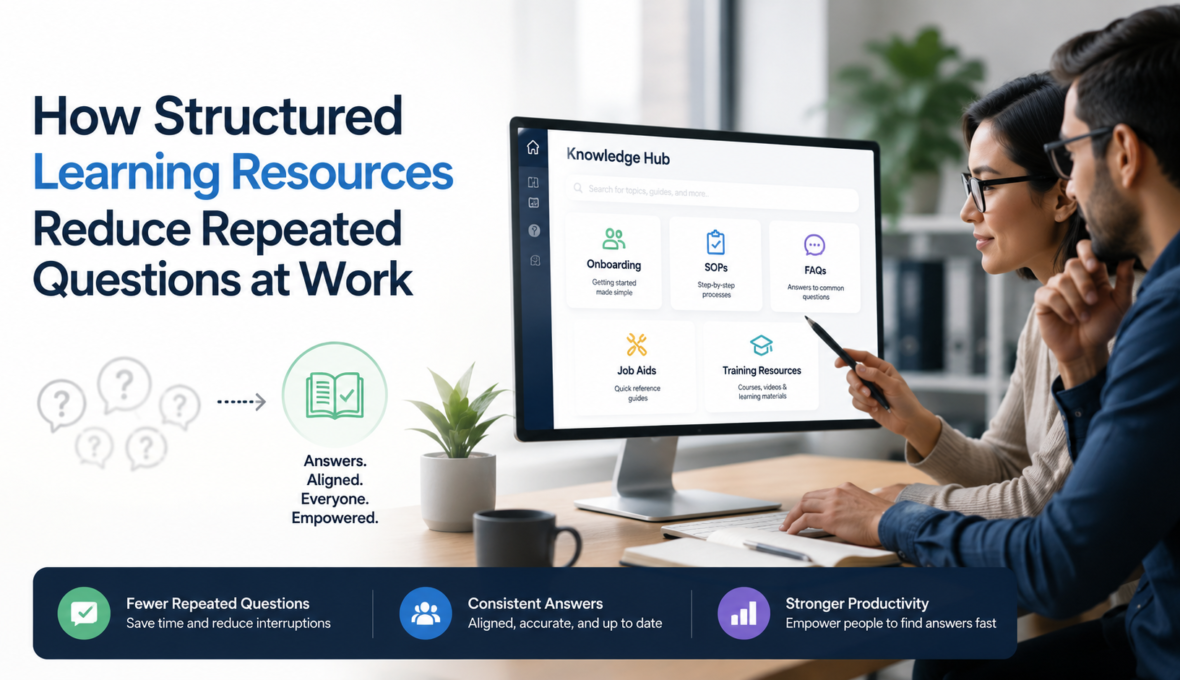
How Structured Learning Resources Reduce Repeated Questions at Work

A team member asks how to complete a process.
Someone explains it.
A few days later, another employee asks the same question.
The answer is given again.
Then someone else joins the team, and the conversation starts all over.
At first, this may look like a communication problem or a sign that employees are not paying attention. But repeated questions at work are not always caused by unwillingness to learn.
Sometimes, the information people need has never been properly organised, documented or made easy to find.
Important instructions may be sitting inside old emails, meeting recordings, chat conversations, personal notebooks or the memory of one experienced employee.
When that happens, people are forced to ask.
Structured learning resources give employees somewhere reliable to turn before they interrupt a colleague, wait for a manager or make an avoidable mistake.
They turn repeated explanations into reusable support.
Repeated questions are often a systems problem
When employees keep asking the same questions, it is easy to blame the individual.
Managers may think:
- We have already explained this.
- Why does no one remember?
- Why does the team need so much supervision?
- Why can they not work this out themselves?
But before assuming that employees are careless, it is worth examining the system around them.
Was the information only shared verbally?
Was it explained during one meeting without a reference resource?
Is the written process outdated?
Are there several versions of the same instruction?
Do employees know where the correct information is stored?
Can they understand the resource without needing someone to explain it again?
Information is not automatically useful simply because it has been documented.
A long document stored inside an unfamiliar folder may technically contain the answer, but it does not necessarily help someone who needs clear guidance while completing a task.
The problem is not always a lack of information.
It is often a lack of structure.
What are structured learning resources?
Structured learning resources are materials designed to help people understand information, complete tasks and apply what they have learned.
They present information in a logical order and make it easier for employees to find the right answer at the right time.
Examples include:
- Employee onboarding guides
- Standard operating procedures
- Process checklists
- Step-by-step job aids
- Training workbooks
- Video demonstrations
- Frequently asked question pages
- Knowledge bases
- Quick-reference guides
- Templates and examples
- Decision trees
- Troubleshooting guides
- Role-specific learning pathways
The right format depends on what the employee needs to understand or do.
A complex process may require a detailed guide and video demonstration. A recurring task may only need a one-page checklist. A customer support team may benefit from response templates, escalation guidance and a searchable knowledge base.
The purpose is not to create more documents.
The purpose is to create the right support.
How structured learning resources reduce repeated questions
1. They create a reliable source of information
Repeated questions increase when employees receive different answers from different people.
One manager explains a process in one way. Another team member uses a different approach. An old document gives instructions that no longer apply.
Employees become uncertain about which version is correct, so they continue asking for clarification.
Structured resources create a clear reference point.
Instead of depending on whoever happens to be available, employees can access one approved and up-to-date source.
This improves consistency and reduces confusion.
2. They make information easier to find
Employees may already have access to the information they need, but that does not mean they can find it.
A workplace can have hundreds of documents and still leave employees without practical support.
Information should be:
- Clearly named
- Organised by role, process or topic
- Stored in an accessible location
- Easy to search
- Linked to related resources
- Reviewed and updated regularly
A resource called “Final Process Document Updated Version 3” is less helpful than one called “How to Process a Customer Refund.”
Clear organisation reduces the time employees spend searching and the need to ask someone else.
3. They support employees while they work
Training often happens before employees encounter the real situation.
Someone may attend an onboarding session, watch a presentation or complete a course. But when they need to perform the task several weeks later, they may not remember every detail.
That is normal.
A job aid, checklist or quick-reference guide provides support at the point of need.
Instead of expecting employees to remember everything, the organisation gives them a resource they can use while completing the task.
This is especially useful for:
- Processes completed occasionally
- Tasks involving several steps
- Compliance-related activities
- Customer service procedures
- Software or system instructions
- Escalation processes
- Tasks where mistakes are costly
The goal of learning is not to prove that employees can memorise every instruction.
It is to help them perform effectively.
4. They improve employee onboarding
New employees naturally ask questions.
The problem arises when every new employee depends on repeated verbal explanations for the same basic information.
Without structured onboarding resources, managers and experienced team members may spend hours explaining:
- How systems work
- Where documents are stored
- Who handles each responsibility
- How to complete routine processes
- What to do when something goes wrong
- How performance is measured
- When to escalate an issue
A structured onboarding system reduces this burden.
New employees can follow a clear learning pathway containing the information, activities and resources they need at each stage.
This does not remove the human side of onboarding. Employees will still need guidance, feedback and opportunities to ask questions.
However, managers can spend less time repeating basic instructions and more time supporting understanding, confidence and performance.
5. They help employees become more independent
When answers only exist in the minds of managers or experienced employees, the team becomes dependent on those individuals.
Work may slow down when they are unavailable.
Structured learning resources make knowledge more accessible across the organisation.
Employees can check a process, confirm the next step and solve common problems without always waiting for approval or assistance.
This supports greater independence while still giving employees clear boundaries around when they should ask for help.
The aim is not to stop questions completely.
Questions are valuable when they reveal uncertainty, unusual situations or opportunities for improvement.
The aim is to reduce questions that already have clear and repeatable answers.
The resources every team should consider creating
Not every organisation needs a large learning management system or an extensive library of training courses.
Start with the questions employees ask most often.
For each repeated question, consider what kind of resource would answer it clearly.
Frequently asked question guide
Create a simple FAQ covering recurring questions about policies, systems, responsibilities or common workplace situations.
Process guide
Document the full process for tasks that require several steps, approvals or handovers.
Include who is responsible, what tools are used, what should happen at each stage and what to do when something goes wrong.
Checklist
Use a checklist for tasks where employees need to confirm that every required step has been completed.
Checklists are especially useful for recurring processes, quality control and compliance.
Quick-reference job aid
Create a short resource employees can keep open while working.
This might include system shortcuts, response options, decision criteria or essential steps.
Video demonstration
Record a short screen demonstration for tasks involving software, tools or visual processes.
The video should focus on one clear task rather than combining several unrelated processes.
Examples and templates
Showing employees what good work looks like can be more useful than giving instructions alone.
Provide approved examples, completed templates or model responses where appropriate.
Knowledge base
A searchable knowledge base can bring different resources together in one organised location.
It may include policies, process guides, FAQs, videos, templates and troubleshooting information.
How to create resources employees will actually use
A resource can be well-written and still fail if it does not reflect how employees work.
Before developing new materials, speak with the people using the process.
Ask:
- What questions do you receive repeatedly?
- Where do employees usually get stuck?
- Which mistakes happen most often?
- What information is difficult to find?
- Which existing resources are no longer accurate?
- At what point do employees usually need support?
Then design the resource around the actual need.
Use clear language. Break complex information into manageable sections. Include examples. Make the next step obvious.
Where possible, test the resource with someone who is less familiar with the process.
If they cannot use it without further explanation, the material may need to be simplified or reorganised.
Common mistakes organisations make
Creating long documents for every problem
Not every question requires a full training manual.
The format should match the need. A checklist may be more useful than a ten-page document.
Storing resources in too many places
When documents are scattered across email, shared drives, chat platforms and different systems, employees may not know where to look.
Choose one clear location whenever possible.
Failing to update the information
An outdated resource can create more confusion than having no resource at all.
Assign responsibility for reviewing and updating important materials.
Writing for the expert instead of the learner
The person documenting a process may already understand it deeply and unintentionally skip important details.
Resources should be written from the employee’s point of view.
Treating documentation as a replacement for support
Resources should reduce unnecessary dependence, not remove access to managers, trainers or subject-matter experts.
Employees still need feedback, coaching and help with situations that fall outside the standard process.
Repeated questions can reveal what the organisation needs to improve
Repeated questions are useful information.
They show where employees are uncertain, where processes are unclear and where learning support may be missing.
Instead of becoming frustrated by the question, organisations can ask:
Why does this question keep coming up?
The answer may reveal a need for:
- Clearer onboarding
- Better process documentation
- Updated training
- A more accessible knowledge base
- A practical job aid
- Better communication between teams
- A clearer division of responsibilities
Every recurring question is an opportunity to improve the learning system around the work.

Frequently Asked Questions
What is a structured learning resource?
A structured learning resource is a clearly organised material that helps someone understand information, learn a process or complete a task. Examples include job aids, onboarding guides, training workbooks, checklists, videos and knowledge-base articles.
Why do employees keep asking the same questions?
Employees may repeat questions when information is unclear, difficult to find, inconsistent, outdated or only explained verbally. Repeated questions can indicate that the workplace learning or knowledge-sharing system needs improvement.
Can documentation completely eliminate employee questions?
No. Employees will still need support with complex, new or unusual situations. The purpose of documentation is to reduce routine questions that already have repeatable answers, not to discourage employees from asking for help.
What is the difference between a training resource and a job aid?
A training resource helps someone learn or understand a topic. A job aid supports the employee while they are completing a specific task. Some resources can serve both purposes.
What should an employee knowledge base contain?
An employee knowledge base may include policies, process instructions, FAQs, templates, onboarding information, troubleshooting guides, training videos and role-specific reference materials.